
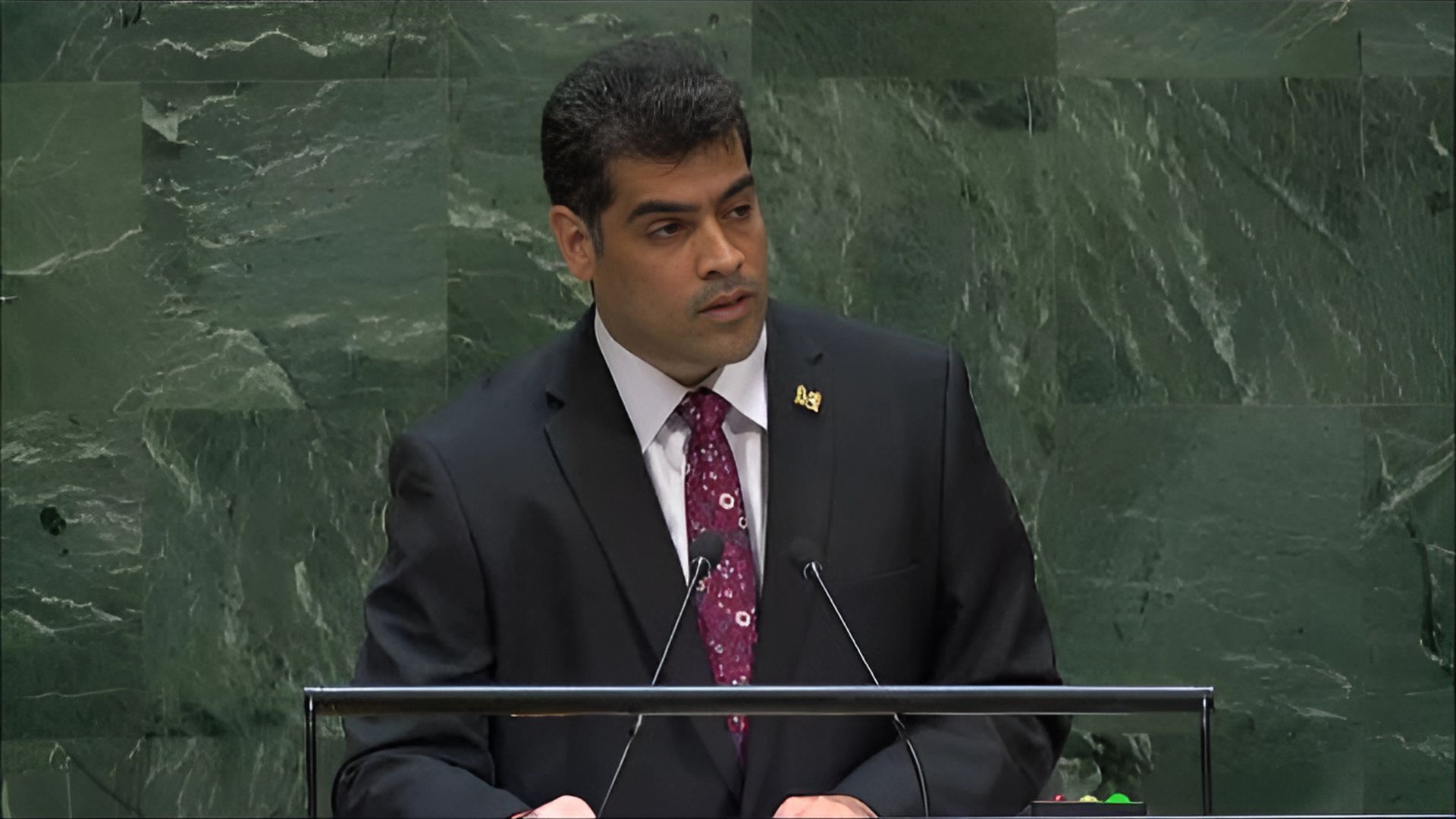
Ashwin Adhin, Vice-President of the Republic of Suriname, addresses the general debate of the 74th Session of the General Assembly of the UN (New York, 24 – 30 September 2019).
Full Speech
Statement by H.E. Michael Ashwin Adhin
Vice President of the Republic of Suriname
At the General Debate of the 74th Session of the United Nations General Assembly
New York, 26 September 2019
Please check against delivery.
Your Excellency Tijjani Muhammad-Bande, President of the General Assembly
Excellencies,
Distinguished Delegates,
Introduction
Mr. President,
On behalf of His Excellency Desiré Delano Bouterse, President of the Republic of Suriname, I extend to you sincere congratulations on your election to preside over the 74th session of the United Nations General Assembly.
I also take this opportunity to acknowledge Her Excellency María Fernanda Espinosa Garcés for her skillful leadership during the previous session, and I wish her continued success in her future endeavors.
A. Environment
Mr. President,
Diversity characterizes Suriname.
This diversity is also reflected in our environment.
Suriname is identified as the most forested country on the planet, with a firm commitment to preserve 93% of its forest cover. It is also recognized—alongside Bhutan—as one of the most carbon-negative countries in the world.
Our nation boasts a unique biodiversity. In 1998, Suriname became the first country to set aside, for scientific research and conservation purposes, 11% of its landmass—1.6 million hectares—as a gift to humanity. An ambitious contribution, even by the standards of that time.
Mr. President,
It is therefore understandable that, from our perspective, Suriname—like many nations represented here today—is deeply concerned about the effects of global climate change.
In this regard, we express our solidarity with the Government and people of the Bahamas, as well as with all those affected by the recent hurricanes.
Climate Change and Environmental Action
Once again, parts of a small Caribbean nation were wiped out.
Is it a coincidence that, within less than three years, several Caribbean countries have been struck by the strongest category hurricanes? Or is this a time-telling phenomenon—that climate change has already become a fact of life, with its devastating effects?
Mr. President,
I wholeheartedly agree with the Secretary-General regarding climate change when he states that now is the time for action—not for empty speeches and promises.
It is in this spirit that Suriname initiated and hosted the first High-Level Meeting for High Forest Cover, Low Deforestation (HFLD) countries in February 2019. Since 2007, HFLD developing countries have received less than 2 billion USD in climate finance—less than 14% of all climate funds committed.
At this conference, the “Krutu of Paramaribo Joint Declaration on HFLD Climate Finance Mobilization” was adopted, representing the collective interest of 27 participating developing countries. These HFLD countries committed to taking action and increasing their access to climate finance in order to maintain their intact forests.
Suriname has been mandated by this group to lead the HFLD developing countries in achieving the joint objectives outlined in the Paramaribo Declaration.
We therefore call for strong ambition and concrete actions towards global mitigation and adaptation efforts—especially regarding access to climate finance.
B. Peace and Security
Mr. President,
The report by the Secretary-General on the work of the Organization underlines a troubling picture of the current state of world affairs concerning peace and security.
When I state that “diversity characterizes Suriname,” I also refer to the fact that Suriname is home to a population comprising at least seven major world cultures.
The message from our National Anthem is both strong and clear:
“Wans’ ope tata komopo, Wi mu’ seti kondre bun.”
Wherever you may have come from, we must build a prosperous nation.
C. Regional Peace, Dialogue, and Cooperation
This spirit of unity has inspired us, as a diverse people, to advance toward building a prosperous nation. It has also helped prevent inter-ethnic clashes, as Suriname is renowned for its harmony, tolerance, and respect for all religions and cultures, fostering peaceful coexistence among its citizens.
Mr. President,
At the regional level, Suriname has consistently promoted and contributed to the Caribbean and South American region as a Zone of Peace.
Yet today, we are confronted with tensions and growing mistrust among states—states that for decades enjoyed excellent political, economic, social, and diplomatic relations.
In the Latin American and Caribbean region, countries have long worked to preserve and promote:
- Peace and security,
- Political stability,
- Social inclusion,
- And political cooperation.
Therefore, Suriname reiterates the critical importance of:
- Respect for the principles of non-intervention and non-interference in the internal affairs of states,
- Dialogue, diplomacy, and the peaceful resolution of conflicts,
- As well as political and economic cooperation as essential building blocks for durable peace, stability, and democracy.
Seven Notable Points
- Firstly, we applaud the recent steps taken by parties within the Bolivarian Republic of Venezuela to reach common ground through meaningful dialogue.
- Secondly, Mr. President, our colonial past has presented Suriname with unresolved border issues along both the western and eastern parts of our territory.
We are confident that a solution to secure our territorial integrity will be found in the near future.
Suriname is intentionally choosing the path of dialogue to resolve these lingering matters. - Thirdly, in addressing land rights for our Indigenous and tribal peoples, we have developed a roadmap aimed at achieving legal recognition of these rights within the Surinamese legal and social context.
- Fourth, in response to the recent forest fires in the Amazon region, Suriname welcomed the Leticia Pact—a regional call to preserve and sustainably develop the Amazon.
During this process, we emphasized the importance of:- Inclusion of all Amazonian countries as stakeholders in a living Amazon,
- Rising above political differences,
- Organizing meaningful provisions to ensure the development of Indigenous and tribal communities, and
- Upholding the sovereignty of each country and of the Amazon as a shared regional heritage.
Continuation of Seven Notable Points
Mr. President,
- We consider the ongoing trade disputes among major international players a serious challenge, with far-reaching consequences for our local economies as well.
In the same vein, we strongly oppose blacklisting and the arbitrary seizure of funds, especially when such actions are taken without due regard for their severe impact on the economic stability of countries.
These unwelcome actions remain major obstacles, often beyond the control of many nations. An atmosphere of trust and political will is crucial, and should serve as a foundation for dialogue and cooperation. - Similarly, we strongly disapprove of the continuation of the more than half-century-old economic, financial, and commercial embargo against the sister Republic of Cuba and its people.
Repeatedly, the vast majority of nations have taken a stance against this embargo.
One must now ask: Is it not finally time to recognize that the continuation of these measures has been—and will remain—counterproductive? - Lastly, Mr. President, Suriname, with its extensive open borders and sparsely inhabited hinterland, continues to be a victim of trans-border illicit drug trafficking.
The recent adoption of the National Drug Master Plan (2019–2023) demonstrates our firm resolve to combat this illicit trade.
A key component of this plan is international cooperation.
In this context, Suriname co-chaired the bi-regional partnership between the European Union (EU) and the Community of Latin American and Caribbean States (CELAC) under the Coordination and Cooperation Mechanism on Drugs.
This collaboration resulted in the adoption of a guiding document containing practical measures to address illicit drug trafficking and drug-related transnational crime.
D. Youth Participation and the UN Youth Strategy
Mr. President,
Concerning our youth:
Today, we are all witnessing how young people are courageously voicing their concerns about the future they are inheriting—and rightfully so.
As the Lead Head for Youth in the Caribbean Community (CARICOM), Suriname strongly advocates for youth involvement as a prerequisite for sustainable development.
We have made a deliberate and strategic choice to fulfill that expectation.
Suriname prides itself on an intergenerational approach—one that provides real opportunities for youth to engage and participate at all levels of decision-making.
Indeed, youth are an integral part of the Surinamese delegation here today.
E. The 2030 Sustainable Development Agenda
Mr. President,
Threats and opportunities related to achieving the goals of the 2030 Agenda for Sustainable Development have become a central topic of concern for all nations.
Each Member State faces its own set of challenges.
- Economic Resilience and Reform
In this regard, Suriname notes the economic stagnation caused by the sharp decline in global market prices of crude oil and gold between 2013 and 2015. This downturn significantly reduced Suriname’s foreign currency earnings and impacted the national economy.
In response, the Government launched a home-grown reform program—so termed because we recognize that our people are our greatest asset in the path to development.
In 2010, President Desiré Delano Bouterse envisioned and initiated a Social Contract with the people of Suriname.
Key pillars of this contract include:
- Universal healthcare
- A general pension system
- A minimum hourly wage
- Access to affordable housing
- Education for all
Despite the economic crisis, the Government remained committed to this vision.
Today, Suriname’s economy is steadily recovering.
We have experienced positive growth in two consecutive years—2017 and 2018—while inflation has dropped from double digits to a single-digit figure, and continues to decline.
As of mid-last year, annual inflation dipped below 5%.
Furthermore, both exports and imports have shown significant improvements compared to the crisis years.
- Unfair Economic Classification
Secondly, I must highlight a persistent and unresolved obstacle that undermines our efforts to achieve the SDGs: our classification as a middle-income country.
This classification—based solely on GDP per capita—fails to account for our structural vulnerabilities and developmental needs.
Like many other developing nations, especially in the Caribbean, we strongly reject this unrealistic and limiting classification.
It ignores the complex challenges we face and must be urgently reconsidered.
Access to concessional financing remains critical for accelerating the implementation of the 2030 Agenda.
- Institutional Strengthening and Strategic Planning
Thirdly, we emphasize our newest endeavor and key priority in advancing the SDGs: the strengthening of our National Planning Institute.
This institute is now extending its reach across all government bodies and implementing results-based management for both our annual plan and national budget.
Its strengthened role will:
- Enhance long-term development strategy formulation
- Improve data collection and analysis
- Deliver reliable statistics
- Enable more responsive and evidence-based decision-making
The capacity and effectiveness of this core planning institution are therefore seen as critical to the successful implementation of the 2030 Agenda—and it now stands as one of our highest national priorities.
F. The Way Forward
In closing, Mr. President,
We live in a world that is increasingly characterized by the urgent need for cooperation to address the many serious challenges we face.
Suriname firmly believes that the United Nations remains the most important organization to confront the complex issues facing the international community—an organization committed to finding inclusive, balanced, and sustainable solutions while taking into account the interests of all Member States.
It is therefore essential that the United Nations becomes a more efficient and effective multilateral institution—one that is adequately resourced and fit for purpose to meet the challenges of our time and those ahead.
Suriname recognizes the vital role the United Nations can—and must—play in ensuring lasting development and peace.
But it is up to us, the Member States, to make this vision a reality.
Mr. President,
We can make this work.
I thank you.
Bron: https://youtu.be/JWwYjjFY5jA